Statins and Cholesterol Treatment in Older Adults: Benefits Proven at Any Age
Jan 25, 2026
Benefits To Treating Cholesterol In The Old And Very Old
You will see a lot of misinformation published by medfluencers trying to convince you that there is no benefit to taking statins if you are above a certain age. They tried so hard to find studies that didn't show benefit, and they couldn't find them. Trial after trial showed benefit in older people. So they decided to make up their own study. This is typically what these online grifters do. When they can't find proof, they just make it up.
They published their own meta analysis and excluded studies that had mortality data in them. They also excluded any studies that disproved their point. They were finally able to torture the data enough to publish a study that showed that perhaps a person over the age of 60 might not benefit from statins. Although, this is not what the data actually shows, as we will see below. They just made it up by bending the data and cherry picking enough studies.
The reason they did this is so that they can all publish contrarian books. Nine of the authors on this one paper all had "cholesterol doesn't matter and statins are evil" books to sell. They did not disclose their conflicts of interest. They went on to cite their own research in their books. This is intellectual dishonesty at its finest.
One such book is The Cholesterol Myth book. The Cholesterol Myth book concluded that treating the elderly with statin therapy had no benefit. They argued that people over the age of 60 should not attempt to lower their cholesterol. This flies in the face of every study we will discuss, as they all had participants over the age of 60, and they benefited.
Medical note: This article is for general education and is not a substitute for advice from your own doctor. Never start or stop a medication without talking to your doctor.
Key takeaways
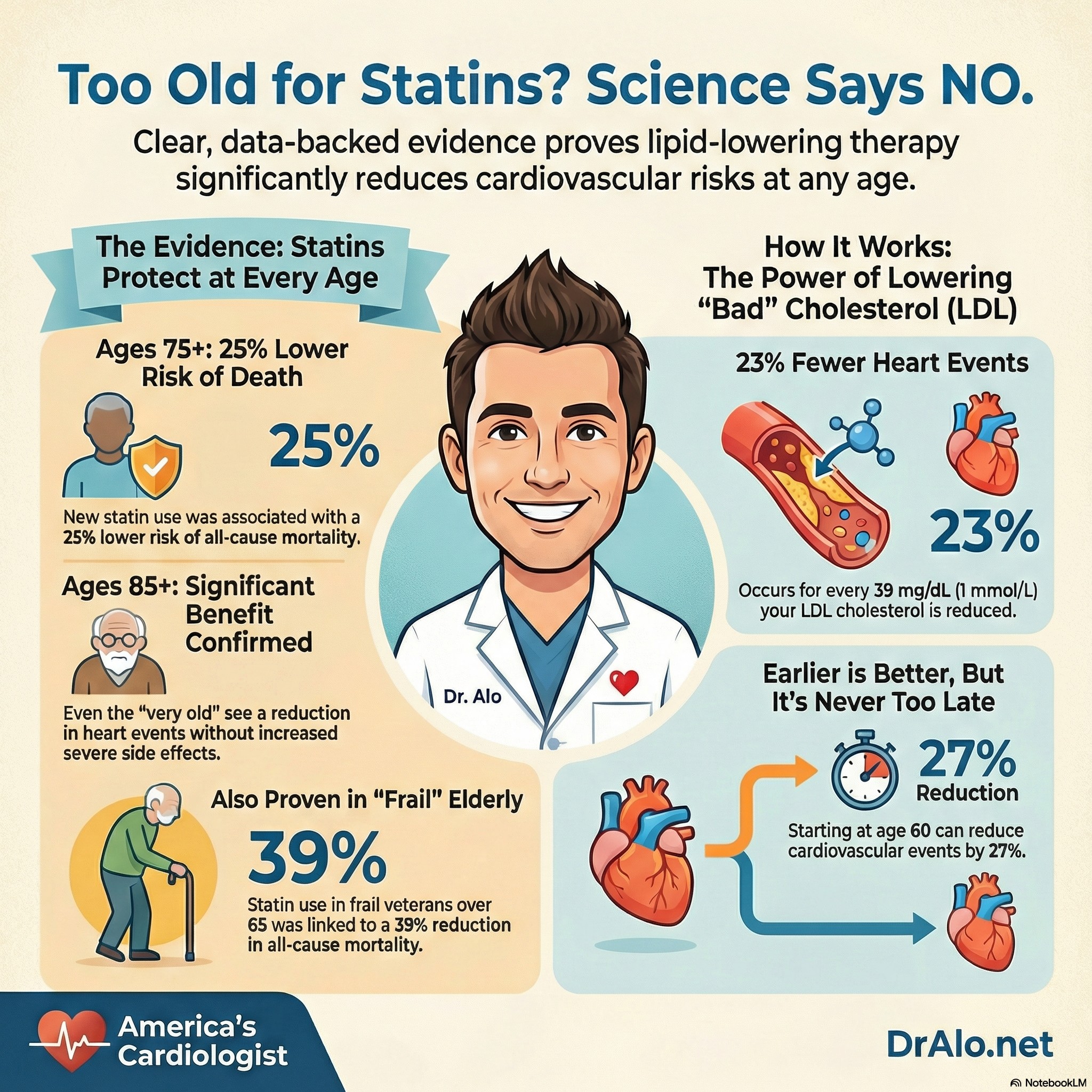
- In adults 50 to 75, treating 100 people with a statin for 2.5 years prevents one heart attack, stroke or cardiovascular death.
- In 6 trials of older adults, lipid-lowering therapy cut cardiovascular events by 25% overall, and by as much as 39%.
- Each 1 mmol/L (about 39 mg/dL) lower LDL cut events 23% after age 70, the same as in younger people.
- Starting at 60 still means about 27% fewer events by age 80. Earlier is better, but it's never too late.
- In frail veterans, in people over 75, and even in people over 85, starting a statin was linked to fewer events and deaths.
Graphical summary of this article to share:
Statins Reduce Risk In Those Age 50 To 75

Figure: time needed on a statin to prevent one major cardiovascular event. Redrawn from Yourman LC, et al. JAMA Intern Med. 2021 (Results).
"Evaluation of Time to Benefit of Statins for the Primary Prevention of Cardiovascular Events in Adults Aged 50 to 75 Years" pooled 8 randomized trials with 65,383 adults who did not have heart disease.
The study found that adults 50 to 75 years of age have significant benefit from statin use for primary prevention. The exact opposite of what The Cholesterol Myth book concluded. It's just not as sexy, and no one is making up studies to sell you a book.
- Each bar is how long it took to prevent one event (a heart attack, stroke or cardiovascular death).
- Within 0.8 years, 1 event was prevented for every 500 people treated. Within 1.3 years, 1 for every 200.
- The pink bar: within 2.5 years, 1 event was prevented for every 100 people treated. That's a number needed to treat (NNT) of 100. Pretty low by today's standards.
And the benefit keeps growing the longer you stay on it.
https://jamanetwork.com/journals/jamainternalmedicine/fullarticle/2773065
Statins In those Over 65 Reduced Risk Of Heart Attacks And Strokes

Figure: percent fewer cardiovascular events in primary prevention trials of older adults. Redrawn from Khan SU. J Am Coll Cardiol. 2023 (figure).
Another review looked at trials that included older adults without heart disease, to see if lipid lowering therapy made a difference. It did.
- Each row is one trial. The bar is how much lipid-lowering therapy cut events. The whiskers are the margin of error.
- The navy bars were significant on their own: JUPITER in people 70 and older (39% fewer events), EWTOPIA with ezetimibe in people 75 and older (34%), and HOPE-3 (25%).
- The grey bars were too small to be sure on their own, because their whiskers cross zero.
- The pink bar is all 6 trials combined: 25% fewer events.
You'll also notice that the trials with stronger LDL lowering, like JUPITER with rosuvastatin, showed the biggest benefit. The lower the LDL, the better the risk reduction.
From:
https://www.jacc.org/doi/10.1016/j.jacc.2023.08.005

Figure: percent fewer major cardiovascular events per 1 mmol/L lower LDL, older vs younger. Redrawn from Gencer B, et al. Lancet. 2020 and Andersson NW, et al. J Am Coll Cardiol. 2023.
Another study from October 2023 in the Journal of the American College of Cardiology also demonstrated significant reductions in risk regardless of age. In a nationwide Danish study of people with no heart disease who started a cholesterol-lowering medication, each 1 mmol/L (38.6 mg/dL) reduction in LDL-C meant 23% fewer major cardiovascular events in people 70 and older, and 24% fewer in people under 70. Statistically, that's the same benefit.
A 2020 Lancet meta-analysis of 29 randomized trials found the same thing in people 75 and older: 26% fewer events per 1 mmol/L lower LDL, no different from younger patients.
From:
https://www.jacc.org/doi/full/10.1016/j.jacc.2023.07.027
Is it ever too late to start statin or lipid lowering therapy?
No.

Figure: estimated lifetime reduction in major cardiovascular events to age 80 from lowering LDL by 50% (from 135 mg/dL), by the age treatment starts. Redrawn from Ray KK, et al. World Heart Federation Cholesterol Roadmap 2022. Global Heart. 2022 (Figure 3A).
If your LDL-C was 135 mg/dL and you cut it in half starting at age 60, you would have about 27% fewer major cardiovascular events by age 80. Start at 50, and it's 37% fewer. Start at 40, 46%. Start at 30, 52%.
These are modeled estimates, but the message is clear: earlier is better, and later still counts. Next time someone asks you if it's too late to start, you can show them this chart and this paper by the World Heart Federation. Highly recommend you read it.
https://globalheartjournal.com/articles/10.5334/gh.1154
The absolute reduction in cardiovascular events tracks directly with your starting risk and with how much you lower LDL cholesterol. Older people have higher risk, so they have more to gain.
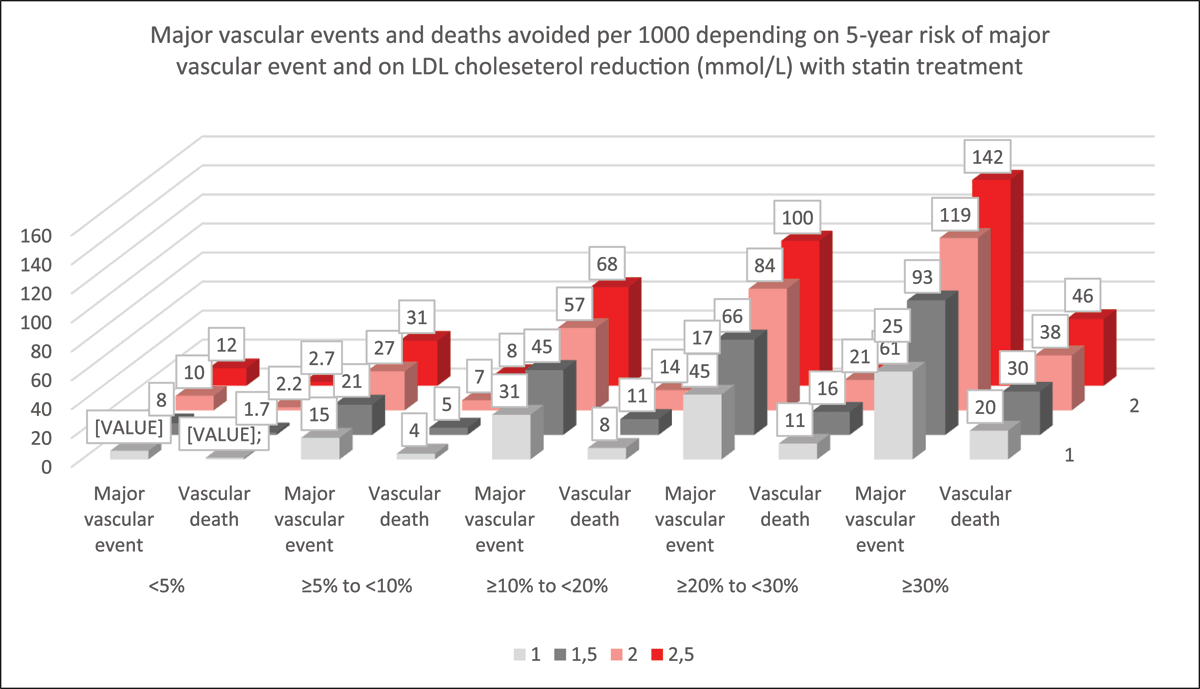
Events avoided based on baseline absolute risk and absolute lowering of LDL-C (Duality of risk and LDL-C lowering as determinants of benefit from lipid lowering therapies). Adapted from CTT Lancet 2012 The effects of lowering LDL cholesterol with statin therapy in people at low risk of vascular disease: Meta-analysis of individual data from 27 randomised trials.
What About Frail Elderly?

Figure: percent lower risk with a statin in older adults. Redrawn from Glynn RJ, et al. Ann Intern Med. 2010; Orkaby AR, et al. JAMA. 2020; Orkaby AR, et al. J Am Geriatr Soc. 2024.
Another study, published in December 2023, looked at 710,313 US veterans over the age of 65, including 86,327 who were frail. Starting a statin was associated with a 39% lower risk of death from any cause and a 14% lower risk of heart attack, stroke, revascularization or cardiovascular death. The benefit was the same whether or not they were frail.
Study:
https://agsjournals.onlinelibrary.wiley.com/doi/10.1111/jgs.18700
What About The Extremely Old? Over 75 And Up To 84 Years Old?
Another large retrospective cohort study of 326,981 veterans aged 75 and older (average age 81) found that new statin use was significantly associated with a 25% lower risk of death from any cause and a 20% lower risk of cardiovascular death. Those are the navy bars in the chart above. The benefit held across people with diabetes, dementia and arthritis.
The top bar in that chart is the strongest evidence: in the JUPITER randomized trial, people 70 and older on rosuvastatin had 39% fewer major cardiovascular events than those on placebo.
https://jamanetwork.com/journals/jama/fullarticle/2767861
What About Those Over The Age of 85?

Figure: percent lower risk for people who started a statin, by age. Redrawn from Xu W, et al. Ann Intern Med. 2024 (visual abstract, intention-to-treat).
Another study from May 2024 showed that statins used for primary prevention in the "old and very old" still demonstrated benefit without increasing risks for severe adverse effects. They defined old as 75 to 84 years of age, and very old as 85 and older.
- The top three bars are heart attack, stroke or heart failure. People who started a statin had 11% lower risk at 60 to 74, 6% at 75 to 84, and 15% at 85 and older.
- The bottom three are death from any cause: 13%, 10% and 15% lower.
- The pink bars are people 85 and older. The benefit held, with no increase in muscle disease or liver problems.
Study:
https://www.acpjournals.org/doi/10.7326/M24-0004
As you can see, every age group had a reduction in risk. Including those over the age of 85!
The fine print
- The veterans studies and the Hong Kong study are observational. People who start a statin may differ in ways the researchers couldn't fully measure. That's why the randomized trials above matter.
- Some single trials were too small to be sure on their own (PATE, ALLHAT-LLT and PROSPER in the older-adult trials chart). Combined, the benefit is clear.
- The lifetime estimates by starting age are modeled, built from genetic studies and trial data.
Lipid Lowering At Any Age Confers Significant Benefit
As you can see from the studies, when you don't cherry pick studies and include all of them, people at every age benefit from lipid lowering therapy. You can ignore anyone that says that lowering cholesterol over the age of 60 does not provide benefit. That simply isn't true.
Reduce saturated fat, increase fiber, and take your medications if you need them. Then do cardio, lift weights, reduce stress and improve sleep. And talk to your doctor about your own numbers, because the decision after 75 should be based on your health and goals, not your birthday.
Send this to anyone who is wondering if they are too old to start a lipid lowering medication!
Related Statin & Medication Posts
- Do Statins Work Over Age 65?
- Do Statins Really Only Add 4 Days?
- Do Statins Only Reduce Risk by 1%?
- Statins And Dementia
- No One Has Side Effects From Statins!
Still have questions? Stop Googling and ask Dr. Alo.
You've read the science, but applying it to your own life can be confusing. That's exactly what the Heart 2 Heart VIP Community is for. You can ask me questions directly, join live video calls where we talk through your labs and situations like this one, and get physician-level guidance based on your actual numbers.
Join here: https://dralo.net/community 💪🏻🩺🫀
Dr. Alo
References
- Yourman LC, Cenzer IS, Boscardin WJ, et al. Evaluation of time to benefit of statins for the primary prevention of cardiovascular events in adults aged 50 to 75 years: a meta-analysis. JAMA Internal Medicine. 2021;181(2):179-185. doi:10.1001/jamainternmed.2020.6084.
- Khan SU. The promise of primary prevention in older adults. Journal of the American College of Cardiology. 2023;82(14):1392-1394. doi:10.1016/j.jacc.2023.08.005.
- Andersson NW, Corn G, Dohlmann TL, et al. LDL-C reduction with lipid-lowering therapy for primary prevention of major vascular events among older individuals. Journal of the American College of Cardiology. 2023;82(14):1381-1391. doi:10.1016/j.jacc.2023.07.027.
- Gencer B, Marston NA, Im K, et al. Efficacy and safety of lowering LDL cholesterol in older patients: a systematic review and meta-analysis of randomised controlled trials. Lancet. 2020;396(10263):1637-1643. doi:10.1016/S0140-6736(20)32332-1.
- Ray KK, Ference BA, Séverin T, et al. World Heart Federation Cholesterol Roadmap 2022. Global Heart. 2022;17(1):75. doi:10.5334/gh.1154.
- Cholesterol Treatment Trialists' (CTT) Collaborators. The effects of lowering LDL cholesterol with statin therapy in people at low risk of vascular disease: meta-analysis of individual data from 27 randomised trials. Lancet. 2012;380(9841):581-590.
- Orkaby AR, Lu B, Ho YL, et al. New statin use, mortality, and first cardiovascular events in older US Veterans by frailty status. Journal of the American Geriatrics Society. 2024;72(2):410-422. doi:10.1111/jgs.18700.
- Orkaby AR, Driver JA, Ho YL, et al. Association of statin use with all-cause and cardiovascular mortality in US veterans 75 years and older. JAMA. 2020;324(1):68-78. doi:10.1001/jama.2020.7848.
- Glynn RJ, Koenig W, Nordestgaard BG, Shepherd J, Ridker PM. Rosuvastatin for primary prevention in older persons with elevated C-reactive protein and low to average low-density lipoprotein cholesterol levels: exploratory analysis of a randomized trial. Annals of Internal Medicine. 2010;152(8):488-496.
- Xu W, Lee AL, Lam CLK, Danaei G, Wan EYF. Benefits and risks associated with statin therapy for primary prevention in old and very old adults: real-world evidence from a target trial emulation study. Annals of Internal Medicine. 2024;177(6):701-710. doi:10.7326/M24-0004.
Still Have Questions? Stop Googling and Ask Dr. Alo.
You’ve read the science, but applying it to your own life can be confusing. I created the Dr. Alo VIP Private Community to be a sanctuary away from social media noise.
Inside, you get:
-
Direct Access: I answer member questions personally 24/7/365.
-
Weekly Live Streams: Deep dives into your specific health challenges.
-
Vetted Science: No fads, just evidence-based cardiology and weight loss.
Don't leave your heart health to chance. Get the guidance you deserve. All this for less than 0.01% the cost of health insurance! You can cancel at anytime!
[👉 Join the Dr. Alo VIP Community Today]
Cardiology & Obesity Medicine