
How to Take Blood Pressure at Home Correctly (So You Can Trust the Numbers)
Dec 31, 2025
How to Take Blood Pressure at Home: A Cardiologist's Complete Guide to Accuracy
Why Taking Blood Pressure at Home Matters (More Than You Think)
Here's what I've learned after years of clinical practice: patients who monitor their blood pressure at home make better decisions about their cardiovascular health, and I make better clinical decisions too.
In-office blood pressure readings are unreliable. You walk into my clinic, you're anxious, you're sitting in a cold room, and boom—your pressure spikes 20-30 points above your actual baseline. That's called white coat syndrome, and it's why I trust home monitoring data far more than a single office visit reading.
The second reason home monitoring matters: consistency. One elevated reading tells me nothing. Ten readings over two weeks tells me everything. It reveals your true baseline, how your pressure responds to stress, sleep, sodium, and exercise. This is clinical-grade data that drives medication decisions, dosing changes, and lifestyle interventions.
If you have hypertension, pre-hypertension, or you're on blood pressure medication, home monitoring isn't optional—it's essential. And if you're doing it wrong, you're literally wasting your time.
Infographic Summary:
The Setup: Choosing the Right Device (Validated Monitors Only)
The first mistake I see patients make: they buy whatever blood pressure monitor is on sale at CVS without checking if it's been validated for accuracy.
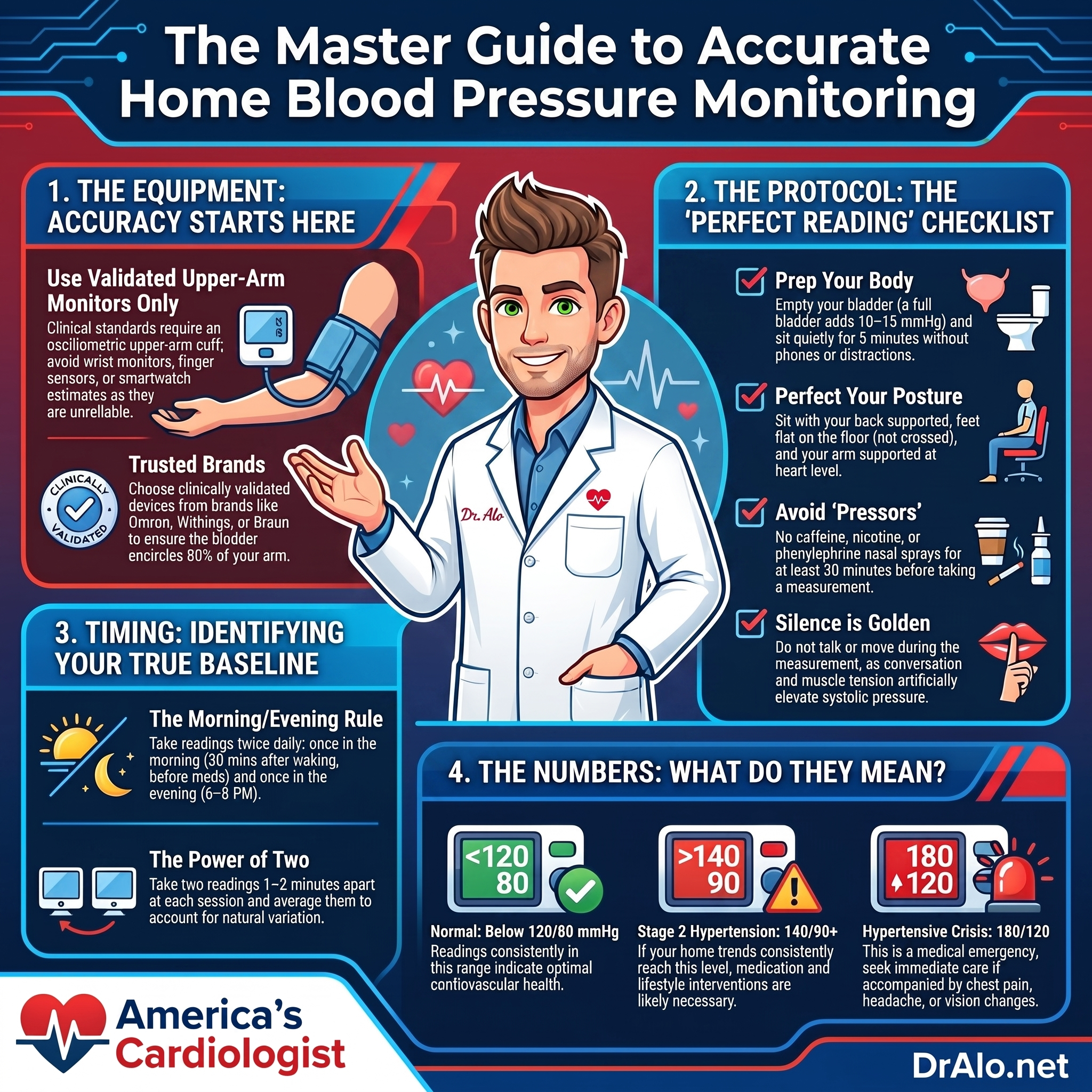
Not all devices are created equal. Wrist monitors, finger monitors, and smartphone apps are often unreliable. The evidence-based standard is an oscillometric upper-arm blood pressure cuff—these are validated in clinical trials and recommended by the American Heart Association, the European Society of Cardiology, and every major medical guideline I follow.
What I recommend to my patients:
✅ Omron, Withings, or Braun upper-arm monitors (clinically validated)
✅ Cuff size that fits your arm properly (the bladder should encircle 80% of your arm circumference)
✅ Devices with data storage or app syncing (so you can track trends and share with me)
✅ Avoid: wrist cuffs, finger monitors, smartwatch estimates, and any device marketed with miraculous health claims
Bottom line: spend $40-60 on a validated device. This is not where you save money.
The Technique: The Exact Steps to an Accurate Reading
Taking blood pressure correctly is boring, but it matters. Here's the protocol I teach patients:
Before You Measure:
✅ Sit quietly for 5 minutes in a calm environment (no phones, no stress, no screaming kids in the background)
✅ Empty your bladder (a full bladder raises readings by 10-15 mmHg—this is documented in the medical literature)
✅ Avoid caffeine, nicotine, and phenylephrine nasal decongestants for at least 30 minutes before measurement
✅ Don't take the reading when you're angry, anxious, or rushed—your pressure will be artificially elevated
During the Measurement:
✅ Sit with your back against a chair, feet flat on the floor (not crossed—crossing your legs raises readings by 3-5 mmHg)
✅ Position your arm at heart level—this is non-negotiable. If your arm is too low, you'll read high. If it's too high, you'll read low. Use an armrest or pillow to support it properly
✅ Keep the cuff on bare skin or very thin fabric (no heavy sleeves—they compress and distort readings)
✅ The cuff should be snug but not tourniquet-tight. You should fit one finger under it comfortably
✅ Don't talk during the measurement (talking raises pressure)
✅ Let the device run without moving or tensing your arm muscles
After the Measurement:
✅ Record the time and your systolic/diastolic readings immediately
✅ Note any unusual circumstances (stress, poor sleep, heavy meal, exercise timing)
✅ Take readings at the same time each day for consistency
Timing: When to Measure (And Why It Matters)
Blood pressure isn't constant—it fluctuates throughout the day in a predictable pattern called the circadian rhythm. If you measure at different times, you're comparing apples to oranges.
The evidence shows that morning readings (within 30 minutes of waking, before taking medication) and evening readings (around 6-8 PM) are most clinically useful. I ask my patients to take readings at the same time each day so I can track true changes versus natural variation.
My recommendation:
Morning: Take two readings, 1-2 minutes apart (after waking, before medication if you take it)
Evening: Take two readings, 1-2 minutes apart (same time each evening)
Average these pairs over a week. This is the data I use to guide treatment decisions—not a single random reading that came back high.
Special circumstances where you should measure more frequently:
✅ If you just started a new blood pressure medication (daily monitoring for 1-2 weeks)
✅ If your readings suddenly spike (this could be medication-related or signal worsening control)
✅ If you're experiencing symptoms like chest pain, shortness of breath, or severe headache (immediate reading, then call me)
Understanding Your Numbers: What Do These Readings Actually Mean?
Systolic over diastolic. That's the readout you see. But what does it mean clinically?
Normal: Below 120/80 mmHg
Elevated: Systolic 120-129 and diastolic below 80
High Blood Pressure Stage 1: Systolic 130-139 or diastolic 80-89
High Blood Pressure Stage 2: Systolic 140 or higher or diastolic 90 or higher
Hypertensive Crisis: Systolic above 180 and/or diastolic above 120 (call 911 if you also have chest pain, shortness of breath, or vision changes)
Here's what I tell patients: don't obsess over a single reading. Look at trends over weeks. If you're consistently in the elevated range (120-129) but not on medication, we need to talk about lifestyle interventions: sodium reduction, stress management, regular exercise (my wheelhouse—exercise is the most underused blood pressure medication there is), and weight loss if applicable.
If you're consistently in Stage 1 or Stage 2, you likely need medication. I don't start patients on blood pressure drugs based on one office visit—I base it on home monitoring data plus cardiovascular risk assessment. That's evidence-based medicine.
Common Mistakes That Ruin Your Readings
I see these errors constantly in clinical practice:
❌ Measuring on the wrong arm: Blood pressure can differ by 10 mmHg between arms. Pick one arm and stick with it consistently for all future readings.
❌ Arm at the wrong height: If your arm is below heart level, you read high. If it's above, you read low. This is basic cardiovascular physiology.
❌ Measuring too soon after waking: Your pressure naturally spikes in the morning. Wait 30 minutes after waking and before medication.
❌ Taking caffeine or nicotine before measuring: Both acutely raise blood pressure. Wait at least 30 minutes.
❌ Measuring when anxious or stressed: Your sympathetic nervous system is activated, your pressure is artificially elevated. Measure when you're calm.
❌ Legs crossed during measurement: This raises readings 3-5 mmHg. Feet flat on the floor.
❌ Loose or improperly fitting cuff: If the cuff isn't snug against your skin, readings will be inaccurate. Check the fit.
❌ Talking during the measurement: Conversation raises blood pressure. Stay quiet until the device finishes.
❌ Full bladder: A full bladder increases systolic pressure by 10-15 mmHg. Empty it before measuring.
❌ Trusting wrist or finger monitors: Upper-arm devices are the evidence-based standard. Everything else is less reliable.
Red Flags: When to Call Your Cardiologist Immediately
Most elevated readings can wait for your next scheduled appointment. These cannot:
✅ Systolic above 180 and/or diastolic above 120 accompanied by chest pain, shortness of breath, vision changes, or severe headache. Call 911.
✅ Systolic above 180 even without symptoms. Call me or go to urgent care the same day.
✅ A sudden spike in readings (e.g., you're normally 130/80 and suddenly you're 160/100). This could indicate medication changes needed or an acute problem.
✅ Readings that don't improve despite following the techniques above perfectly. This signals inadequate medication control.
Integrating Home Monitoring Into Your Care Plan
Home blood pressure monitoring is only valuable if you act on the data. Here's how I use it clinically:
At your next visit, bring your readings (or send them to me via the patient portal beforehand). We'll review the data together and decide:
✅ Is your current medication dose working?
✅ Do we need to adjust medications?
✅ Are lifestyle modifications making a difference?
✅ Is there a pattern we can address (e.g., your pressure spikes on work days—stress management needed)?
Home monitoring is a tool that informs treatment. It's not a replacement for medical care—it's a complement to it. I've prevented countless cardiac events, strokes, and kidney disease by using home monitoring data to make timely medication adjustments and lifestyle interventions.
FAQ: Common Questions About Taking Blood Pressure at Home
Q: How to measure blood pressure at home accurately?
Use an upper-arm oscillometric monitor on bare skin. Sit with your back supported, feet flat, arm at heart level, for 5 minutes of quiet rest. Avoid caffeine and nicotine for 30 minutes prior. Take readings at the same time daily (morning and evening), and average two readings 1-2 minutes apart.
Q: What is the best time to check blood pressure at home?
Morning readings within 30 minutes of waking (before medication if applicable) and evening readings around 6-8 PM are clinically most useful. Measure at the same time daily for consistency. Average readings over a week to identify true trends.
Q: Are home blood pressure monitors accurate?
Upper-arm devices from validated manufacturers (Omron, Withings, Braun) are clinically accurate when used correctly. Wrist monitors and smartwatch estimates are less reliable. Accuracy depends more on proper technique than on the device itself.
Q: How many times should I check my blood pressure at home?
For routine monitoring, take two readings in the morning and two in the evening, then average them. Do this daily or at least 4-5 days per week. For new medications, measure daily for 1-2 weeks. For symptoms, measure more frequently and contact me.
Q: What position should I be in to take blood pressure at home?
Sit with your back supported against a chair, feet flat on the floor, arm at heart level. Stay quiet and still during measurement. Arm position is critical for accuracy.
Q: When should I call my doctor about home blood pressure readings?
Call 911 if you're above 180/120 with chest pain, shortness of breath, vision changes, or severe headache. Call the same day for readings above 180/120 without symptoms. Contact me if readings remain elevated despite perfect technique.
Q: What can affect blood pressure readings at home?
Caffeine, nicotine, stress, anxiety, full bladder, crossed legs, incorrect arm position, and loose cuff fit all affect readings. Measure in a calm state after 5 minutes of rest, at the same time daily.
Q: Can I take blood pressure on my wrist at home?
Wrist monitors are less reliable than upper-arm devices. The clinical standard is an oscillometric upper-arm cuff. Wrist devices may be convenient for travel but shouldn't replace upper-arm measurements for medical decisions.
The Bottom Line: You're a Data Collector Now
Home blood pressure monitoring transformed my practice. I stopped making medication decisions based on one office visit. I started treating actual baseline pressure, not white coat syndrome. I started seeing patterns in my patients' cardiovascular response to lifestyle changes.
And my patients got better outcomes: fewer hypertensive crises, fewer emergency department visits, better medication compliance, and a genuine partnership in their cardiovascular care.
You can do the same. Get a validated upper-arm monitor. Learn the technique correctly. Measure consistently. Bring your data to your next visit. And understand that home monitoring isn't just about taking readings—it's about empowering yourself to manage your cardiovascular health with actual data, not guesswork.
Your heart depends on it. And so does your long-term health.
Take Control of Your Cardiovascular Health Today
Blood pressure monitoring is one tool. But sustainable cardiovascular health requires a comprehensive approach: evidence-based medications when needed, targeted lifestyle modifications, and medical guidance that cuts through the noise of supplement culture and wellness misinformation.
If you want to dive deeper into cardiovascular disease prevention, medication management, and actually proven strategies for longevity, I'm building a community for people like you—people who want real science, not marketing.
Join me in the Heart 2 Heart VIP Community at dralo.net/community. You can text me directly with questions, join live video calls with me each week, and connect with others who are serious about protecting their cardiovascular future.
💪🏻🩺🫀 Dr. Alo
References:
American Heart Association: Monitoring Your Blood Pressure at Home
CDC: Checking Your Blood Pressure
Mayo Clinic: High Blood Pressure Readings
JAMA: Home Blood Pressure Monitoring and Cardiovascular Outcomes
Still Have Questions? Stop Googling and Ask Dr. Alo.
You’ve read the science, but applying it to your own life can be confusing. I created the Dr. Alo VIP Private Community to be a sanctuary away from social media noise.
Inside, you get:
-
Direct Access: I answer member questions personally 24/7/365.
-
Weekly Live Streams: Deep dives into your specific health challenges.
-
Vetted Science: No fads, just evidence-based cardiology and weight loss.
Don't leave your heart health to chance. Get the guidance you deserve. All this for less than 0.01% the cost of health insurance! You can cancel at anytime!
[👉 Join the Dr. Alo VIP Community Today]
Cardiology & Obesity Medicine